
 Subscribe to the newsletter
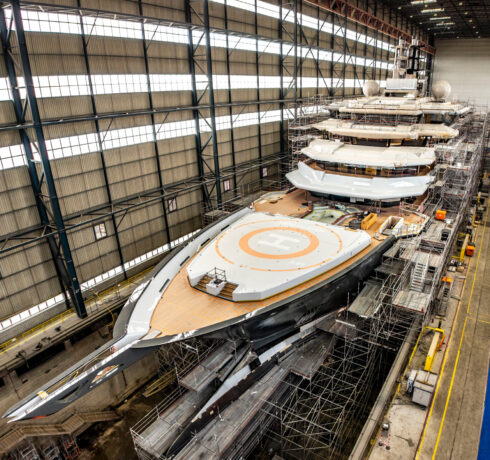
When the REV Ocean first arrived at Damen Shiprepair Vlissingen on 8 March 2025, it marked the start of the biggest project in DSV’s history. The shipyard was tasked with the interior and exterior outfitting of the 194.9-metre-long, state-of-the-art research and expedition vessel. Now, the project is entering its final phase, and DSV’s focus is shifting from major construction and outfitting activities towards finishing, installing, and commissioning the huge number of individual elements throughout the vessel.
Text: Tom Scott
In this article, DSV’s three REV Ocean project managers, Wicherd Knetemann, Maarten Oele and Wesley de Marco, talk about their respective areas of work.
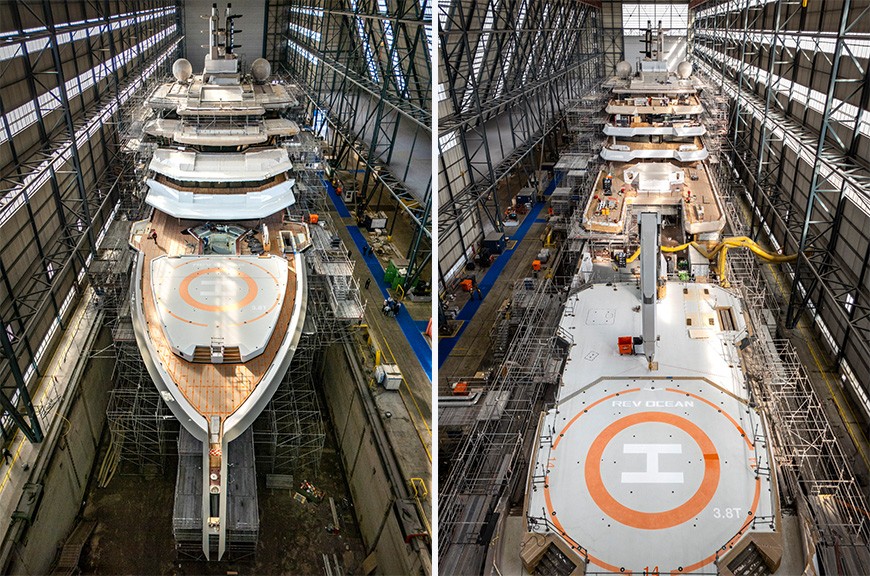 The REV Ocean project is now entering its final phase.
From construction to finished interior
Since the previous update for the Schelde Schakels, the changes in the vessel’s interior are particularly noticeable. Wicherd, who has joined DSV from Damen Yachting to support the owner’s team and manage DSV’s own interior-related scopes, says this is due to the significant quickening of pace.
“The outfitting speed of the luxury interior basically went from zero to 100% this year,” he says. The installation and finishing of the large atrium staircase, which connects decks two to eight, meant that work on the interior could really speed up. In fact, a total of four interior outfitting companies are now fully engaged.
“A typical luxury interior outfitting contractor can handle around 500 to 1,000 square metres. However, on the REV Ocean, there are almost 4,000 square metres of luxury interior to complete. The vessel is simply too big from an interior point of view for one company to do everything safely and efficiently,” Wicherd explains. “This means that we have some areas where the interior subcontractors are just starting to install luxury finishes, and other areas that are already in the final phase of inspections. For example, of the 15 guest cabins on the main deck, 11 have already undergone their first inspection.” The non-luxury areas of the vessel’s accommodation were already finished on arrival.
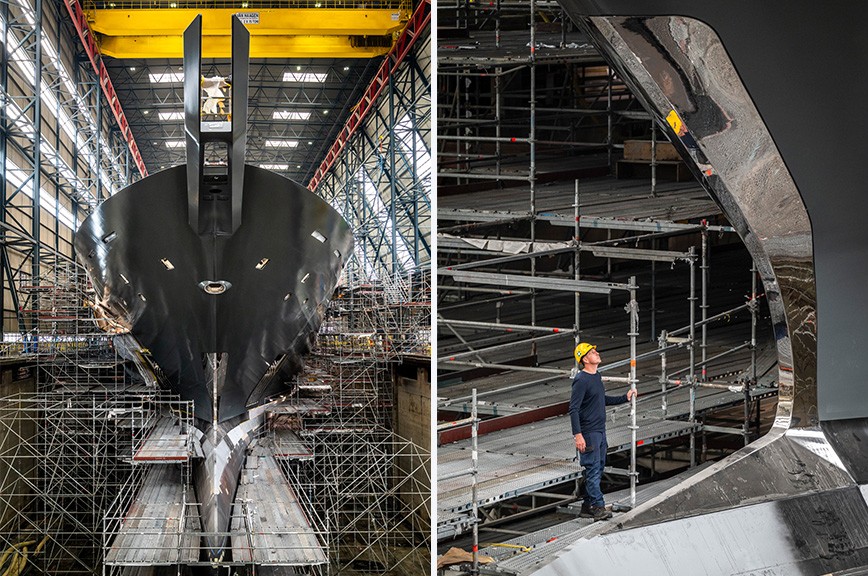 Around 95% of the painting of the hull and superstructure work is now finished.
Exterior work enters the final stretch
The outside of the REV Ocean is also nearing completion. Around 95% of the painting of the hull and superstructure work is now finished. Maarten, who manages the exterior scope of the project, says that one major decision was to grit blast the underwater hull back to the first primer layer before applying the anti-fouling coating. This was due to concerns about the adhesion of the anti-fouling coating.
“The goal of the antifouling is to leave the vessel in the water for ten years,” Maarten explains. “So if there’s any doubt about the adhesive properties of the paint, you need to remove it from the equation and make sure that you have 100% certainty.” This required careful coordination with the ongoing painting work on the superstructure. Separate extraction systems and enclosed working areas were needed to prevent contamination between the blasting and painting activities.
One of the more unusual external jobs involved the vessel’s mast. At the beginning of the year, the 13-metre-high mast was removed to provide access to the exhaust system. Maarten: “We installed additional silencers to reduce vibration and noise, requiring modifications to the exhaust line that runs from the generators on deck one up through the vessel.”
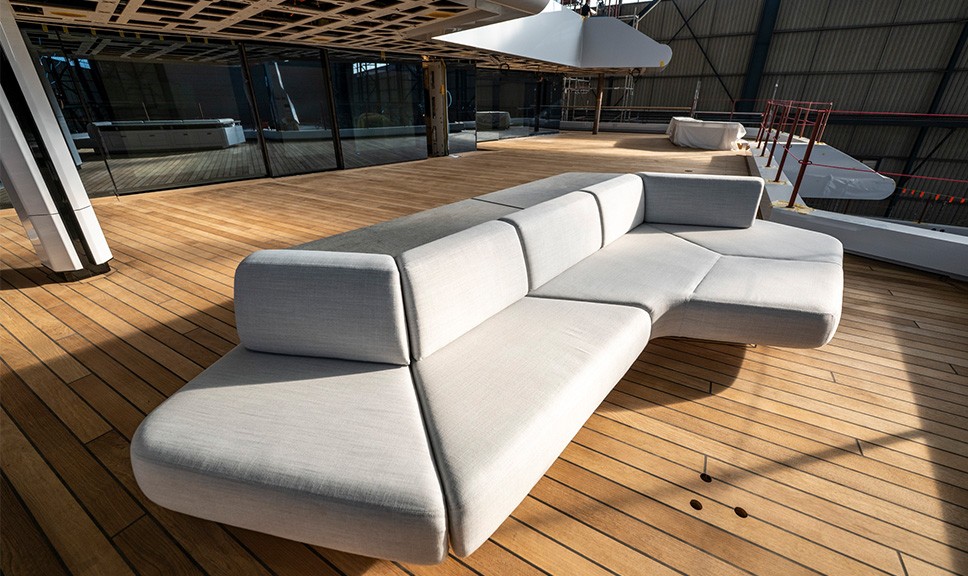 The exterior scope includes the installation of exterior furniture and the Tesumo deck.
Other exterior elements are also taking shape. “Around 80% of the decking has been installed with Tesumo, a more sustainable alternative to teak, made from a fast-growing tree and treated to increase its durability,” adds Maarten.
Additionally, work has started on the polyurethane flooring on the helicopter decks, container decks and in the hangar. Exterior furniture is being installed, the swimming pools are being finished and new railings are being prepared for installation. Maarten: “We expect the new railings to come back from the painting workshop later this week so we’ll get started on installation right away: all 800 metres of it!”
Thousands of planning items converging on Q1 2027
While Wicherd and Maarten are respectively the project managers for the interior and exterior scope, the role of overall project management falls to Wesley. “I work a lot on the contractual and financial aspects as well as working closely with Wicherd and Maarten,” says Wesley.
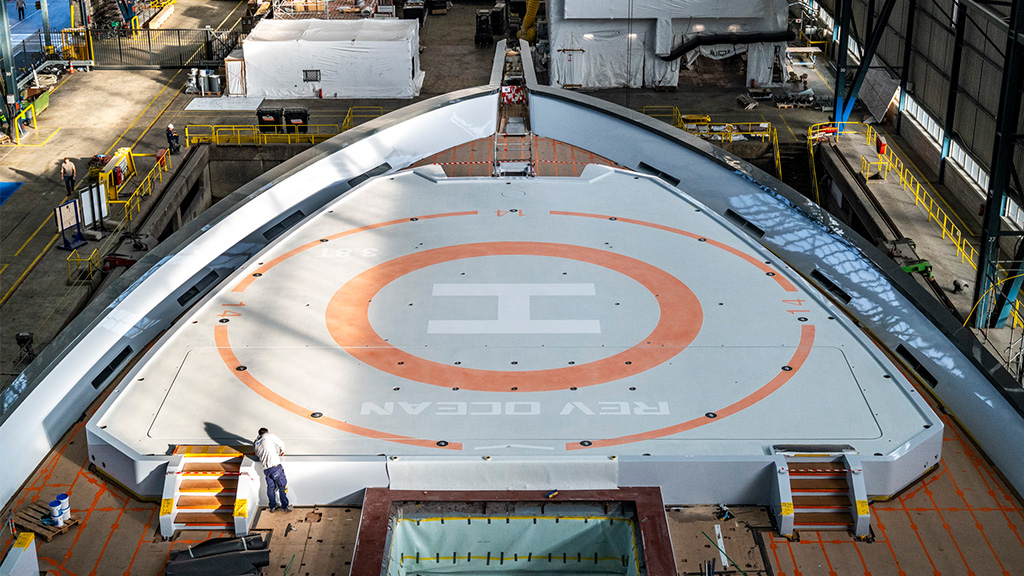 The helicopter decks of the REV Ocean have been covered with a polyurethane coating.
Wesley is therefore a good person to give an overview of the whole project. “To give you an idea of the size of the project, we are working with a total of around 10,000 planning lines. This involves between 450 and 500 people who work on board on a typical day. But with many more involved in workshops, offices and other locations, the total number of people involved could reach around 1,500 at peak moments, which for typical ship repair projects is unheard of,” he notes.
And what does it feel like to walk around a 194.9-metre-long ship with 9 floors? “It’s massive,” replies Wesley. “We can give a very quick tour in 40 minutes, if you want to see everything, including the scientific laboratories, then you could easily walk around there for 3 to 4 hours.”
Preparing to leave the dock
The next major milestone is already approaching: DSV is planning to flood the covered drydock in mid-October. “This will really push the progress with the remaining work as well as getting the vessel commissioning started with the project teams, crew and scientists.” And with the REV Ocean increasingly taking its final form, for DSV’s project management team, the finish line is now clearly in sight. “We are aiming to deliver the vessel in Q1 next year,” concludes Wesley.