
 Subscribe to the newsletter
In the Schelde Schakels series ‘Behind the Scenes’, Damen Naval Senior Communication Advisor Eefje Koppers highlights various departments and activities of the Vlissingen-based Damen companies.
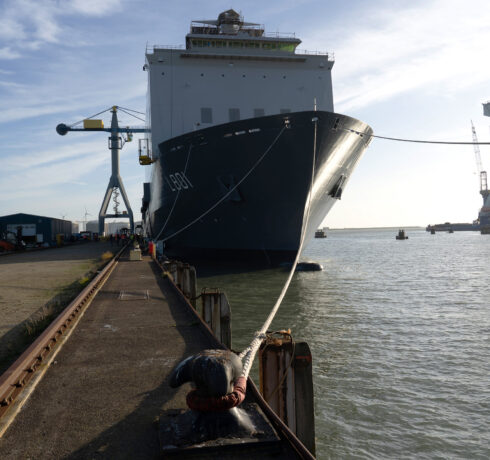
On a cold December morning in 2024, I stood bright and early at our shipyard in Vlissingen-Oost, waiting for Combat Support Ship Den Helder to arrive. The words “CSS Bridge” had been sprayed on the quayside in white paint, so it was clear from the bridge where the 179.5-metre-long ship needed to be positioned. It was a special moment when the ship slowly became visible and came alongside the quay to moor. It was also the moment the seed for this article was planted; because really, how do you moor a ship like that?
Text: Eefje Koppers
At Damen Naval, we call on Gerard Karelse for mooring ships. He started in 1977 at the Royal Schelde’s in-house trade school as a welder and is now Senior Foreman Outfitting, but throughout his career he has seized every opportunity to learn new things and gain more experience. “Besides my training as a welder, I also have experience as a pipefitter and metalworker. I’ve always taken courses to expand my knowledge, because it’s useful to be able to do a bit of everything. The company needs more multifunctional people,” he explains. “I’ve also always been open to helping out when asked for specialist work. Jaap Janse, who has since retired, did a lot of the mooring and unmooring work, and I learned it from him and I followed a course with the Vlissingen Boatmen Company (VLB). You start by helping out, and when people retire, you take over from them.”
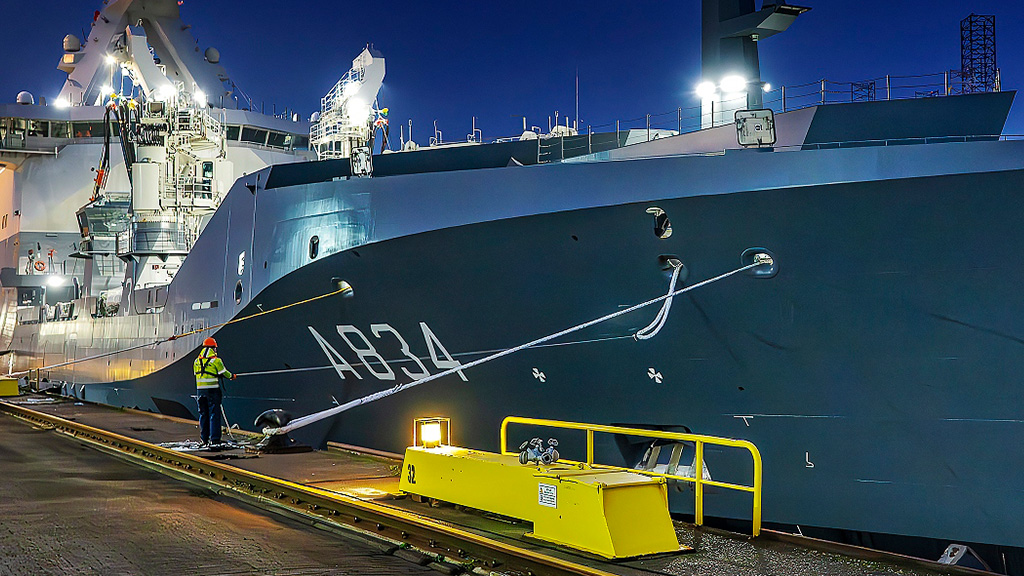 Arrival of the Combat Support Ship Den Helder in Vlissingen: the first mooring line has already been secured and the second is being pulled ashore with the aid of a monkey's fist.
In his nearly 49 years at the Schelde/Damen Naval, Gerard has seen quite a few ships at the yard. “I started on the S-class and M-class frigates. I worked on the hydrographic survey vessels, the TESO ferry Dokter Wagemaker, and the MENAS cargo ship Relume.” When the Holland-class patrol vessels were being built, Gerard was one of the foremen on the project. “As a Foreman, you really see what shipbuilding involves. As a production worker you only do the work you’re brought on board for, but as a Foreman you have to arrange and keep an eye on everything.” It was good training for his later work in warranty support in Den Helder and other projects, such as the construction of the Indonesian SIGMAs and the conversion of M-class frigates HNLMS Van Amstel, HNLMS Van Speijk, and the Belgian Louise-Marie.
Before a ship comes to the yard, there is consultation with the crew about how they want to moor, and a mooring plan is drawn up by the Project Management Office’s Yard & Transport team. This includes, for example, how many and which mooring lines will be used and which bollards the ship will be secured to. A mooring line is a bundle of braided rope ending in a loop, or eye splice, which is often reinforced with pieces of fire hose to reduce wear and tear. In the past, lines were made from natural fibres, but nowadays synthetic fibres are used, since they are lighter, stronger, and don’t rot. Lines come in different diameters, and the ship determines which ones are used.
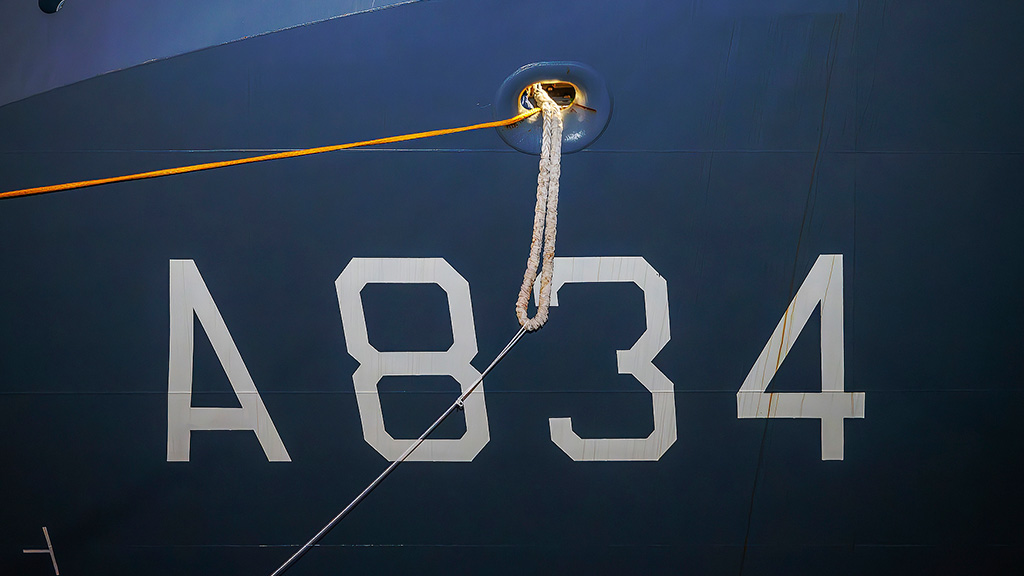 The heaving line attached to the monkey's fist is tied to the mooring line, which is then pulled through the hawsehole to the shore.
From the ship, six types of mooring lines can be secured. The head line runs from the bow diagonally forward to the shore and prevents the ship from drifting backward. The stern line runs from the stern diagonally backward to the shore and prevents the ship from drifting forward. The forward spring line runs from the bow diagonally backward, while the aft spring line runs from the stern diagonally forward. These lines hold the ship in place. Finally, breast lines can also be secured at both the bow and stern. These run at a right angle to the quay and are often used on smaller vessels. Breast lines limit sideways movement and ensure that the ship remains berthed close to the quay.
The moment the ship comes alongside the quay, heaving weights, also known as ‘monkey’s fists’ are thrown from the ship to shore. These are leather pouches filled with sand attached to a heaving line. “Mooring is done in pairs on the quay,” Gerard explains. “At each bollard, two of you wait for the monkey’s fist and lay the line around the bollard.” Once the monkey’s fist lands on the quay, the heaving line is attached to the ship’s mooring line, which is then fed through a hawsehole (also called a fairlead) to the quay. The loop is placed around the bollard, after which work can begin on board to make fast the various lines.
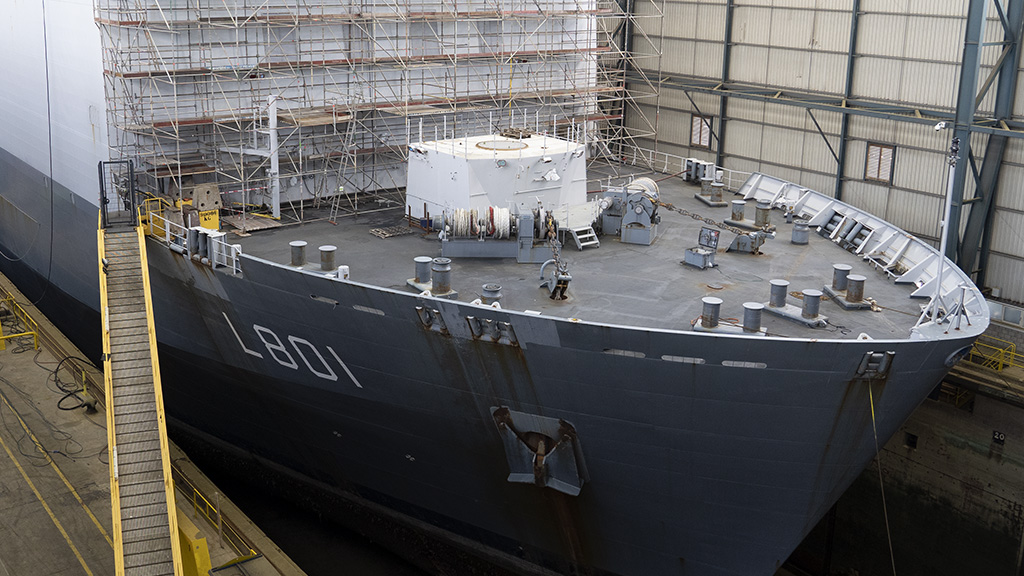 In this photograph of the Midlife Update of HNLMS Johan de Witt in 2022, the foredeck is clearly visible, showing the various bollards to which the mooring lines can be secured.
Although the people on the quayside need to stay alert for flying monkey’s fists, most of the work during mooring happens on board. And if Gerard’s stories are anything to go by, it’s one of the most dangerous jobs a crew carries out. “Lines are subject to wear, and if tension builds up while making fast, the line can snap. Then both ends of the line spring back toward the bollard at tremendous speed.” That snapping motion is also known as the ‘snap-back’ effect, in which the ends of the line whip through the air at enormous speed. This can be extremely dangerous for people on deck and on the quay.
To better illustrate the work, we were given permission to go aboard Landing Platform Dock HNLMS Johan de Witt to see how mooring is done on board. On a naval vessel, the Nautical Department is responsible for, among other things, mooring. Sergeant Major Richard is the Boatswain aboard HNLMS Johan de Witt and took us along to see how his team had moored the ship in the port of Den Helder.
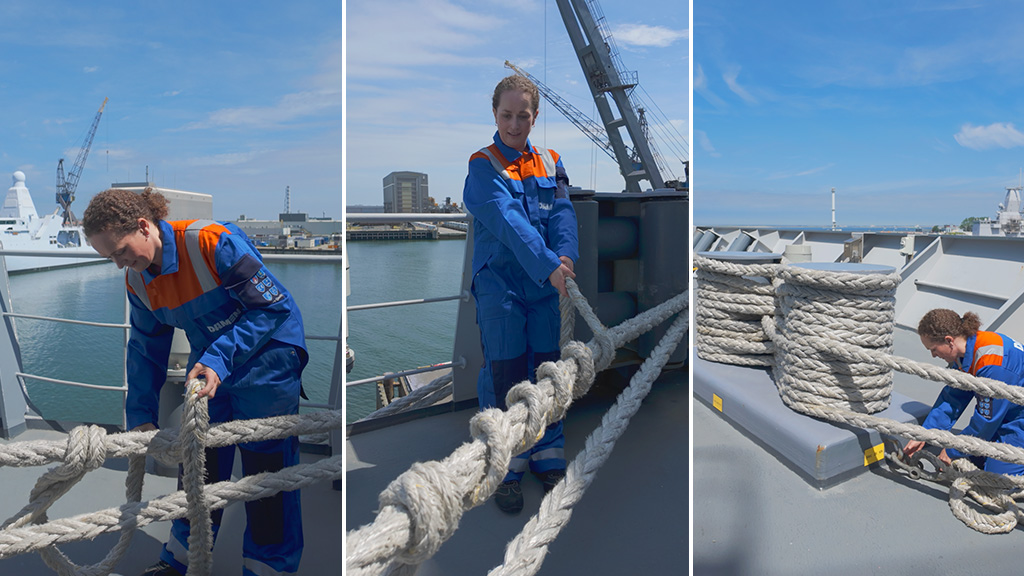 Tying a stop knot prevents the mooring line from slipping, so that it can be safely secured to the bollards. Photos: Mihnea Udrea.
Naval vessels are usually moored with double lines as an extra safety measure. The Johan de Witt was moored on her starboard side, meaning the starboard bollard and centre bollard on the foredeck were being used for the lines. Once the ship is moored and the line loops are secured around the bollards on the quay, the line is wound around a powered winch until the correct tension is reached. A stopper is then applied so the line doesn’t slip loose and can be safely made fast around the bollard on deck. These are double bollards, around which the lines are wound in figure-eights, and two lines fit on one bollard.
Richard showed me how to apply a stopper and explained that this is actually the most dangerous part of the job. Fortunately the ship was already secured, so I could calmly practise applying a stopper myself. It requires not only skill but also strength, because mooring lines are heavy! And in real conditions, multiple lines are being hauled and handled at once. But before you get to that point, there’s another skill the Nautical Department has to master: throwing a monkey’s fist. It’s generally something that’s practised extensively, because it is a bit of an art form.
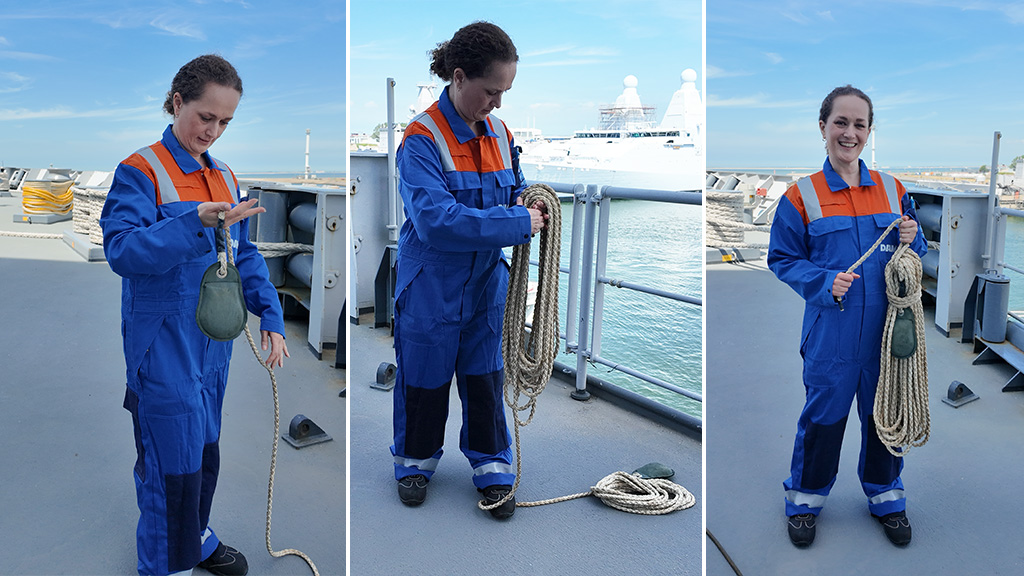 Throwing a monkey's fist is an art in itself, but I have declared my first attempt a success. Photos: Mihnea Udrea.
Before you can throw the monkey’s fist, you first have to prepare the heaving line. You start on the shore side with the monkey’s fist and coil the line around your hand as many times as you can until your hand is full. It’s important to keep the coils of the heaving line neat and sequential rather than tangled, so that the heaving line pays out smoothly when the monkey’s fist flies overboard. In relatively small coils, you wind until you’ve used up about half the line. You lay the coiled portion neatly on the deck and put your foot on the rope, while winding the rest in larger coils around your hand. If you’re right-handed, you hold that portion in your left hand, while holding the monkey’s fist with the shorter coiled section in your right hand.
You take a short run-up, and in theory you should then throw the monkey’s fist in a smooth motion in a straight line toward the quay while the rope pays out effortlessly. I use the term “in theory” deliberately, because for me it of course didn’t happen like that. Where Richard’s monkey’s fist landed neatly, far from the ship, on the quayside (in a lovely straight line), mine plopped down just a few metres from the ship, while the heaving line looked like my knitting projects from primary school: full of knots and completely unrecognisable. If I’d been part of the Nautical Department, I’d undoubtedly have been laughed at, but Gerard and Richard held themselves back admirably. But being the eternal optimist, I declared the experiment a success, since the monkey’s fist had landed on the quay and I still had the other end of the heaving line in my hands to attach to a mooring line.
It was an incredibly educational day aboard one of our ‘own’ ships, and if I ever consider joining the Navy, I’d like to join the Nautical Department. After all, they get to do the most fun things on board. Thanks to the Nautical Department of HNLMS Johan de Witt for their warm welcome. And a special word of thanks to Gerard, who patiently explained all the procedures and terminology to me, and only let me feel just a little bit that I’m no natural talent when it comes to throwing monkey’s fists.