
 Subscribe to the newsletter
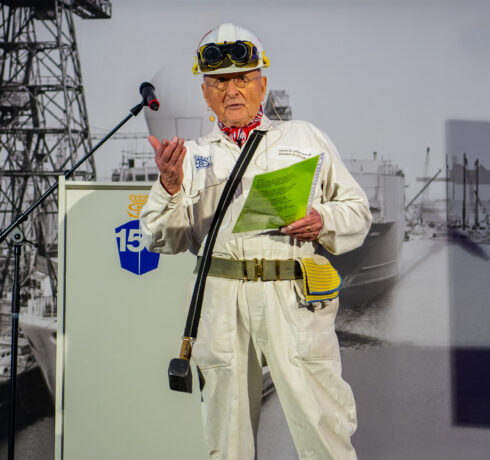
There was a very special guest at the festive launch of the anniversary book ‘Naval Excellence. Dressed in a white Schelde boiler suit, white safety helmet, sturdy work boots and with a riveting hammer slung over his back, 86-year-old Willem Cornelis Murre took to the stage to recite a special poem. The former steel plate worker at the Royal Schelde shipyard began a second career after retiring in 1999: fighting for recognition for the industrious workers of the shipyard.
“It started when I looked around the head office. There are busts of prominent directors, but not a single worker,” Willem explains. “When the yard moved out of the city centre, the workers disappeared from the slipways. That’s when I started thinking about whether something of us labourers could return to that place.”
After years of letters to politicians, talks with the Municipality of Vlissingen and discussions with other former employees, Willem set up the ‘Mannen Tussen Staal’ [English translation: Men Between Steel] foundation in 2016, together with another former Schelde colleague, Herbert Sepers, and his wife, Truus Sepers-Peters. The goal was to create a monument for the workers of the Schelde.
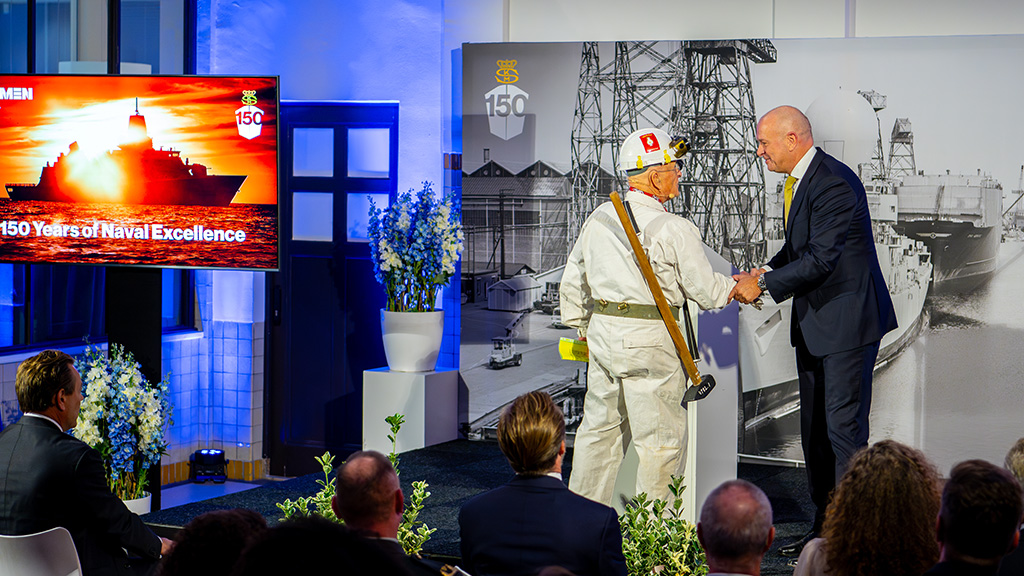 Managing Director Roland Briene welcomes Willem Murre to the stage during the book presentation.
A crowdfunding campaign was launched and the residents of Vlissingen could choose between two artworks. They selected a concrete sculpture by Joris Baudoin, showing two men with a hammer pulling an eight-metre long ship’s chain. The 5,500-kilo artwork was given a temporary home at the Peperdijk in 2017 before being moved early last year to its intended location beside the new city park, De Helling. From there, the sculpture overlooks the spot where Schelde ships once slipped from the North and South slipways.
Willem: “The sculpture is in a beautiful spot where it really comes into its own, and at long last there is recognition for the workers. Without them, none of those ships would ever have existed. They worked in all weathers – storm, snow and rain – out on those slipways and sometimes had only a cup of pea soup and a few fire barrels to keep warm.”
"The sculpture is in a beautiful spot where it really comes into its own, and at long last there is recognition for the workers. Without them, none of those ships would ever have existed." Willem Murre
Willem was born in 1939 in a small house near Borssele. His father worked on a farmer’s land. In 1952 the family moved to Emmeloord in the Noordoostpolder, where Willem discovered how differently people viewed workers in his new hometown. “At the Reformed school in Borssele we had to sit at the back of the class. At this school we sat at the front and they actually asked our opinion.” He has never stopped giving his opinion since.
After leaving school, he went to work on the land with his father, but soon realised it wasn’t for him. He tried various jobs before ending up in road construction as a roller operator. A few years later he had the chance to work in a steel plate workshop, where he learned to weld. During that time he also met his great love, Ina. Due to the housing shortage in Emmeloord, the couple couldn’t find a home after their wedding and lived with Ina’s parents, along with their first baby son, Jan.
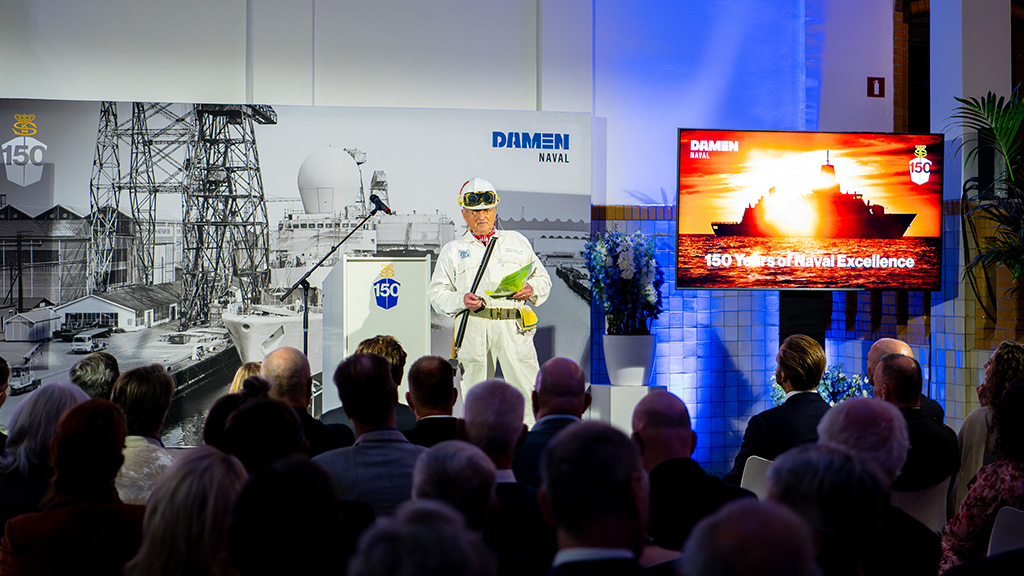 Willem Murre during the reading of his poem 'Battapor'.
In the early 1960s Willem’s parents moved back to Zeeland, and when he went to visit them he was alerted to a job advertisement in the local newspaper for staff at the Schelde. “I went for an interview and was assessed by Jan Weug. I was hired, and my wife and I were driven around in a Mercedes to view three houses. We chose the Irislaan.” After some moving around in Vlissingen and the death of his beloved Ina in 1997, Willem returned to the Irislaan. It’s a different house than before, but he still lives there with great pleasure.
After further training at the Schelde company school and on the job, Willem rose to the position of Department Coordinator at the Schelde. He retired in 1999. Since then, Willem has become a familiar figure in Vlissingen and is often invited to events in the Schelde Quarter. He is a member of the traditional costume society ‘Mooi Zeeland’, which gives presentations and choir performances in care homes and at events across the Netherlands. “It gives me great satisfaction to remain so active and to be able to contribute.”
Throughout his life Willem has kept a diary and written poetry. “Every day I commit my thoughts to my diary. I also kept a record of my years at the Schelde. It helps me organise and record my memories and experiences.” One of his poems is ‘Battapor’, which he wrote for the opening of the new pedestrian bridge from the Jan Weugkade to the Peperdijk, which has been given the same name. This used to be the site of the slipway doors, or ‘bateau portes’; a French term which Schelde workers corrupted into ‘Battapor’.
During the book launch he recited the same poem, winning the hearts of those present. For now, he has no intention of hanging up his boiler suit and riveting hammer. “When I retired, I asked for my personnel file. In it I found the assessment form from my job application. Under ‘first impression’ it said: ‘calm, reliable chap’.” Willem laughs as he says that that judgement may not have been entirely complete, as both during his years at the Schelde and afterwards he has kept hammering on about the importance and recognition of his fellow workers.
Text: Eefje Koppers