
 Subscribe to the newsletter
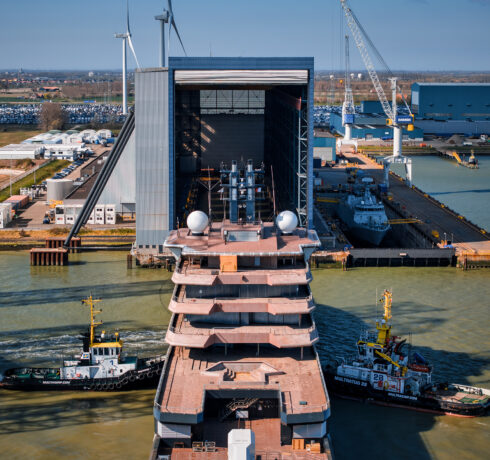
Five months after our last update, the outfitting of the REV Ocean at Damen Shiprepair Vlissingen (DSV) continues to make strong headway. DSV Project Manager Wesley de Marco provides an insight at both the exterior and interior works on this 194.9-metre-long purpose-built Research Expedition Vessel. “We’re really making a lot of progress,” Wesley says. “The painting and filling have gone as we had hoped, and in some areas even a little better. That means that we’re actually ahead of schedule.”
Text: Tom Scott
After completing the exterior grit blasting of the vessel, DSV has divided the exterior scope of the REV Ocean project into two key areas. On the superstructure, conventional filling methods are being applied by a large team of around 110 people. “Some prepare the surfaces, some handle supplies, and others work on the application of the filler itself,” Wesley explains. “You’re imagining it right – 110 people solely working on the superstructure is an impressive sight.”
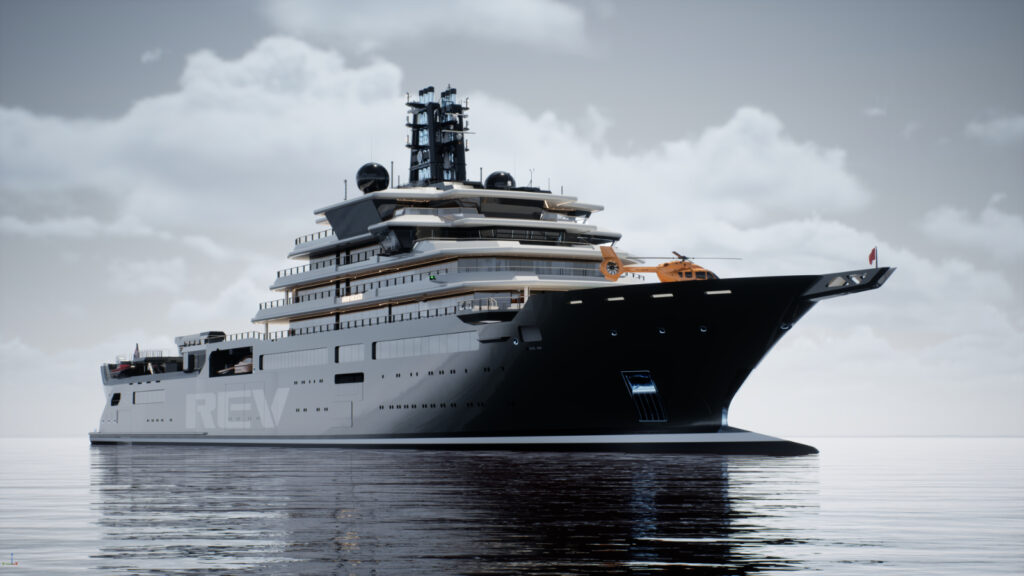 Artist impression of what the REV Ocean will look like after outfitting works at DSV are completed.
For the hull, however, “we have executed it in a new way”, adds Wesley. “We are using a spray filler technique. It’s nice to see the efficiency impact of this new technology. With the application equipment and a different filler substance we needed only 30-40 people and it went very fast. This is where we have made some gains in the schedule.”
This new method of filler application called for some precision preparation. “On arrival, the vessel itself was fully 3D scanned. So called ‘formers’ – reference points indicating the thickness of filler needed at each location – were placed to guide application. “With the scan data, we knew exactly how much filler to apply and when to stop,” Wesley notes. “Some points require almost nothing, others one, two, or even three centimetres. It ensures minimal waste and a very straight surface.”
Completion of the filler application has meant that the painting teams have also made progress. The majority of the superstructure and approximately 80 percent of the hull have been painted.
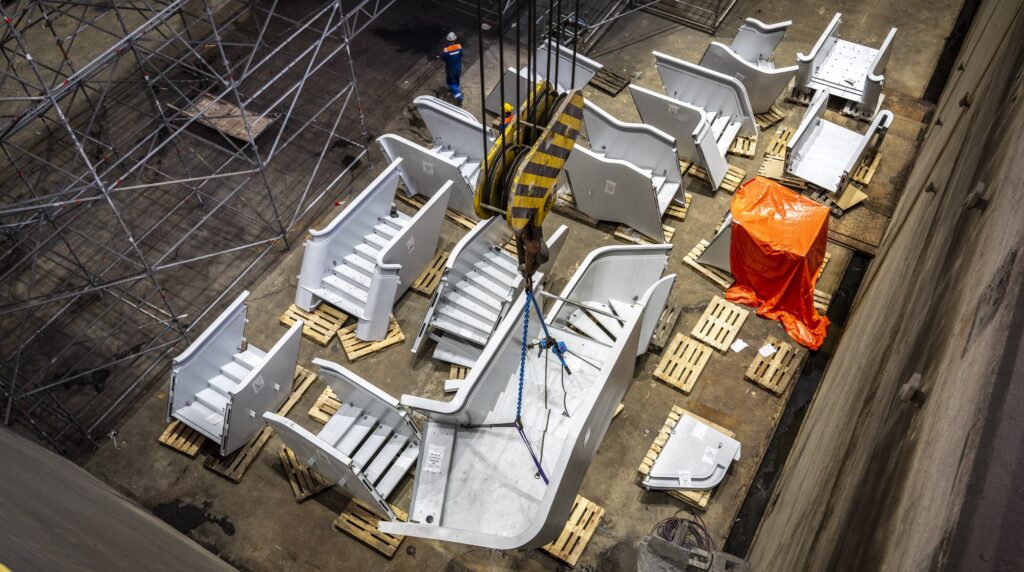 The components of the organically-shaped atrium stairs are awaiting installation on the bed of the dry dock.
The progress seen on the exterior work has been mirrored in the interior scope. “Towards the end of last year, we reached a turning point for the interior with several contracting companies starting their work installing construction panels, and the successful installation of the atrium stairs, an organically shaped stairs connecting deck two to deck eight,” notes Wesley. “And we are in an advanced stage for all electrical scope. That’s really in full swing, which is required to meet the milestones.”
Coordinating exterior and interior works simultaneously is a major logistical challenge. Every major contractor brings a dedicated planner, while DSV provides overall planning integration. “We try to maintain the big picture and make sure everything is achievable,” Wesley says. “If we foresee problems, we adjust before it becomes an actual issue.”
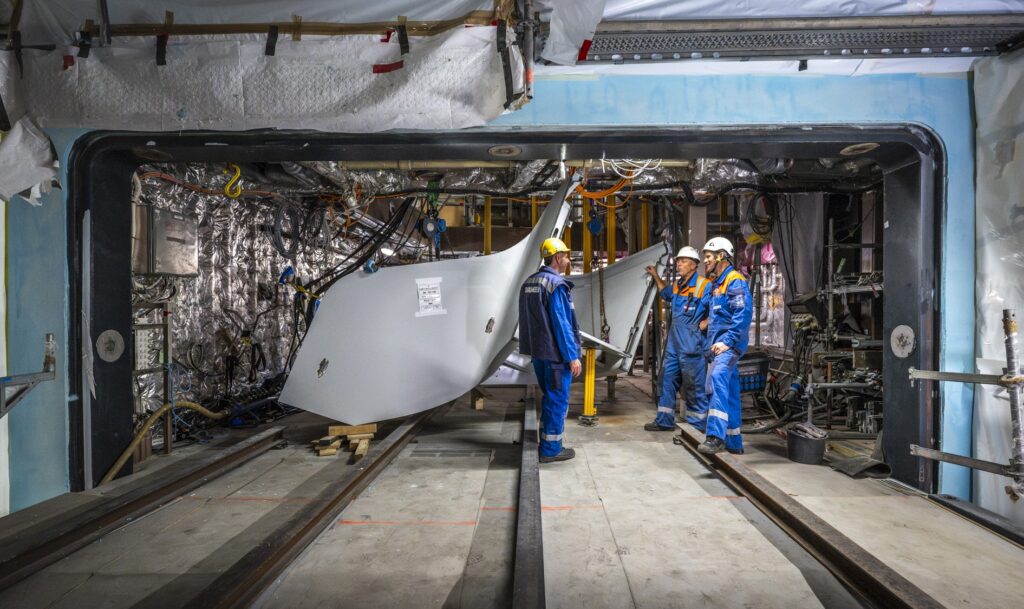 Transport and installation of atrium stair components onboard the REV Ocean.
The scale is huge: more than 450 people are working on-site at peak times, with supporting teams off-site easily increasing the total workforce to over 700. Managing thousands of activities across so many contractors requires meticulous scheduling. “We use Primavera to integrate all inputs,” Wesley says. “We are currently managing around 10,000 line items in our planning.”
Social and collaborative aspects are also part of the scope. DSV hosted drinks – the ‘REV Event’ – in January, bringing together Client, yard and contractors for networking and fun. Moreover, the owner’s project team remains fully involved, working alongside DSV staff on a daily basis. This close collaboration, coupled with the ‘refit-minded approach’ that Wesley mentioned in the previous update, has kept the project on schedule. “It’s this flexibility that keeps us on track,” Wesley concludes.