
 Subscribe to the newsletter
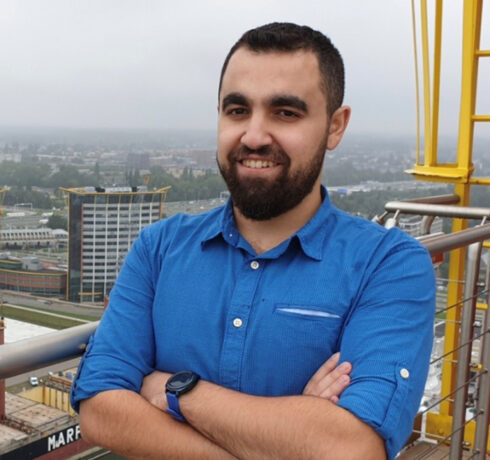
Damen Naval’s Autonomy team has a lot to report from its activities since the previous Schelde Schakels update in April. What was once a ‘one-vessel project’ – the F.A.S.T. Project – involving the conversion of a 1990-built Damen Stan Patrol 900 into an electrically powered and autonomous vessel has expanded to include the development of an autonomous Damen Interceptor 1102. Moreover, the team has welcomed a new colleague into its ranks; Autonomy Engineer Amr Ranneh joined the Autonomy team in April.
Amr started out at Damen Naval as a Systems Analysis Engineer in December 2024 before moving to the Autonomy team in April 2025. “I have a background in mechatronics and systems and control,” says Amr. “Having worked in different industry sectors, I have a multidisciplinary mindset which I think is a good match for the Autonomy team.” Part of Damen Naval’s larger RD&I department, the Autonomy team now consists of four people: Amr, John Spruit, Karine Jansen, and Jochem Nonhebel.
"Once the electric motors have been commissioned, then we can start building the autonomy functionalities." Amr Ranneh
Technical challenges
How has the F.A.S.T. project progressed since April? “Ironically, the F.A.S.T. project hasn’t been going very fast,” replies Amr. “This has been due to numerous technical challenges related to the replacement of the existing diesel engines with the new electric motors. We have had to navigate a lot of learning curves – during which we have had some great help from Pieter de Korte from Engineering Support.”
The causes of the technical challenges are numerous, as Amr explains: “An electric motor is completely different to a diesel engine. They have a smaller footprint and need different gearboxes, different clutching mechanisms, and a lot of additional systems: power management systems, for example. The controls also have to be electric to integrate with the eventual autonomous autopilot system. And the stack of batteries is challenging too because of the cooling, the heating, the humidity, and the enclosure. This is not really the typical work that Damen Naval works on. Usually we work on big vessels – like frigates – instead of small projects like this.”
With the nine-metre long F.A.S.T. vessel still in Vlissingen-Oost, the team is aiming to carry out the first electric test runs on the water in January. “And once the electric motors have been commissioned, then we can start building the autonomy functionalities,” adds Amr.
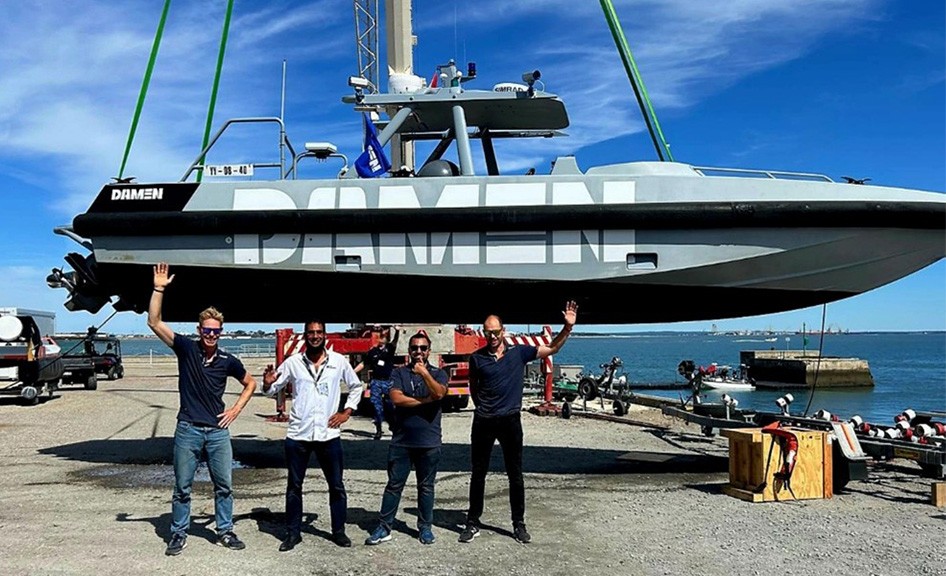 The REPMUS team (from left): Jochem Nonhebel, Ehab El Emam (from RH Marine), Amr Ranneh, and John Spruit.
Enter the Interceptor
Perhaps the main reason for the slow progress on the F.A.S.T. project has been the beginning of a second project consisting of a Damen Interceptor 1102. “We had been invited by COMMIT [the Dutch Materiel and IT Command] to attend REPMUS in Portugal at the beginning of September, taking the Interceptor with us,” says Amr. “This meant that, although F.A.S.T. was not formally put on hold, it became a low-priority item because we were so busy preparing for REPMUS.”
REPMUS is an annual multinational exercise hosted by the Portuguese Navy, and NATO to test and develop a wide range of unmanned maritime, aerial, surface, and ground systems. It brings together military forces and tech companies to experiment with cutting-edge uncrewed technologies. In recent years, it has become the world’s largest exercise for unmanned vehicle experiments. COMMIT attended REPMUS to demonstrate its work with Unmanned Surface Vehicles (USVs) and Unmanned Aerial Vehicles (UAVs). For the purposes of REPMUS, the Damen Interceptor would be classified as a USV.
The Autonomy team’s preparations for REPMUS started with the purchase of a second-hand Interceptor in May. “This vessel’s engines needed updating because the existing engines didn’t have a digital interface; we needed this to allow for digital autopilot controls of steering and thrust. The team worked really hard on the purchase, installation and commissioning of these new engines: getting everything up and running.”
“The Interceptor is a really robust platform; it was a huge success. Also, looking around at how other companies work, we are pleased with our platform-focused way of working. Furthermore, it was interesting to see that, although we had the smallest team of people, we actually had the biggest and fastest vessel." Amr Ranneh
Testing in Den Helder
Next on the schedule was to carry out testing with COMMIT in Den Helder, the scope of which would be repeated during REPMUS. The testing involved COMMIT flying an UAV to an area and locating a floating target. The UAV then sends the GPS coordinates of the target to the Interceptor. The Interceptor than has to make its way autonomously to the GPS coordinates, adequately navigating and complying with collision regulation rules along the way.
Besides the autonomous navigation, the other notable aspect of these tests was the system-to-system communication that COMMIT required. “This means that the UAV sent the GPS coordinates directly to our Interceptor, and not via a control centre; this is a nice capability that COMMIT wanted us to have,” notes Amr.
Portugal, here we come
After transporting the Interceptor to Portugal, the team readied the vessel for the all-important demonstrations – this time with an international audience.
“The nice thing about REPMUS was the location, near the Tróia peninsula and close to the Atlantic Ocean,” says Amr. “This made things more varied than the conditions in Den Helder, which maybe were too ideal. At REPMUS, however, our Interceptor had to interact with vessels from other navies and USVs from other companies.”
Was the REPMUS demonstration a success? “Definitely,” smiles Amr. “The Interceptor is a really robust platform; it was a huge success. Also, looking around at how other companies work, we are pleased with our platform-focused way of working. Furthermore, it was interesting to see that, although we had the smallest team of people, we actually had the biggest and fastest vessel. What’s more, we had a large Damen logo printed on the side of the vessel, which when speeding around at 50 knots, definitely created an impact.”
After returning from REPMUS, the team evaluated the status of the Interceptor project. “To this end, we have compiled a roadmap for the plan ahead, linking that with upcoming commercial projects. Of course, it’s nice to take on nice technical challenges in the engineering world, but you have to be realistic and connect it with a commercial-driven aspect. This ensures that you are delivering something that is valuable to the market, and valuable to Damen Naval.”
Now a two-vessel project
Damen Naval’s Autonomy team is now working on two vessels: a Stan Patrol 900 and an Interceptor 1102. “Of course, there’s a difference in speed and seaworthiness between these two vessels, but that makes it a great choice. We can diversify our development based on these two different sailing profiles, and yet – in terms of autonomy – staying on the same level of intelligence and coordination, and comparable in terms of architecture and functionality.”
Text: Tom Scott