
 Subscribe to the newsletter
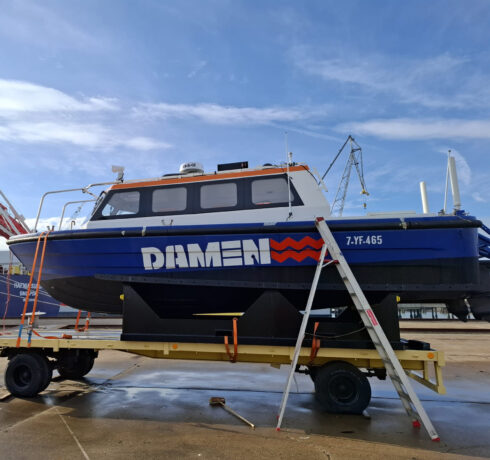
Damen Naval’s autonomous sailing project recently reached a new milestone. The Stan Patrol 900 of the Fieldlab Autonomous Sailing Technology (F.A.S.T.) has now been converted into a fully electric vessel and was recently relaunched. Electrical Automation Engineer Pieter de Korte has been involved in the project from almost the beginning, and we spoke with him about the latest developments and looked back on the past four years since F.A.S.T. started in November 2021.
Text: Eefje Koppers
“The relaunch is definitely a milestone. It was of course a bit exciting to see whether the boat was watertight, but everything went well,” Pieter says. “With the electric motors installed, the boat can sail emissions-free, and we are now conducting endurance tests to measure the range and see whether the platform is stable.”
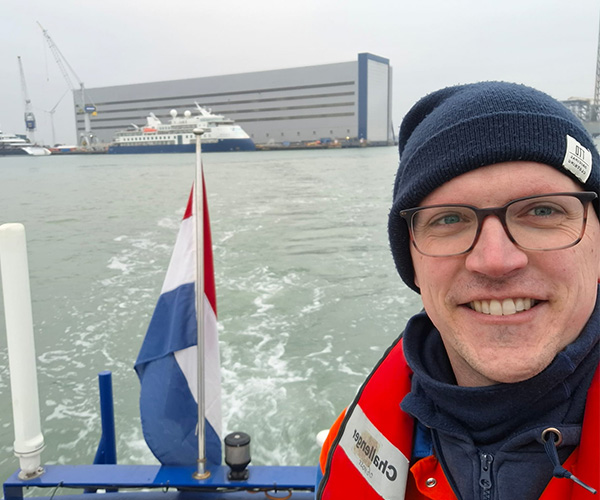 Electrical Automation Engineer Pieter de Korte.
There are now batteries on board and a charging unit to recharge them using shore power. “Charging is still a challenge, because we depend on ports with high-voltage connections, so we need good route planning. We will be testing that over the coming months as well,” Pieter explains. With all the new equipment on board, the boat has become considerably heavier. “An extra ton of weight has been added. During the relaunch we noticed that the transom now sits slightly deeper in the water, but we can solve that by adjusting the ballast in the bow.”
The boat is currently moored at the quayside in Vlissingen-Oost while work continues. “What we’re working toward in the coming months is full autonomy. We are installing the computers and sensors on board and bringing the systems and interfaces online. There are also many tests coming up. We hope to be able to sail fully autonomously this summer.”
The F.A.S.T. project officially started on 17 November 2021, as a collaboration between Damen Naval, the Province of Zeeland, the Municipality of Vlissingen, HZ University of Applied Sciences, TU Delft, and local companies such as Kloosterboer, Vlaeynatie, Captain AI, and Zeeland Boten. A 1990-built Damen Stan Patrol 900 was purchased as a test platform. The project received a grant from the European EFRO program as part of the European Union’s response to the COVID-19 pandemic. Over the past few years, the project has mainly been funded by Damen Naval.
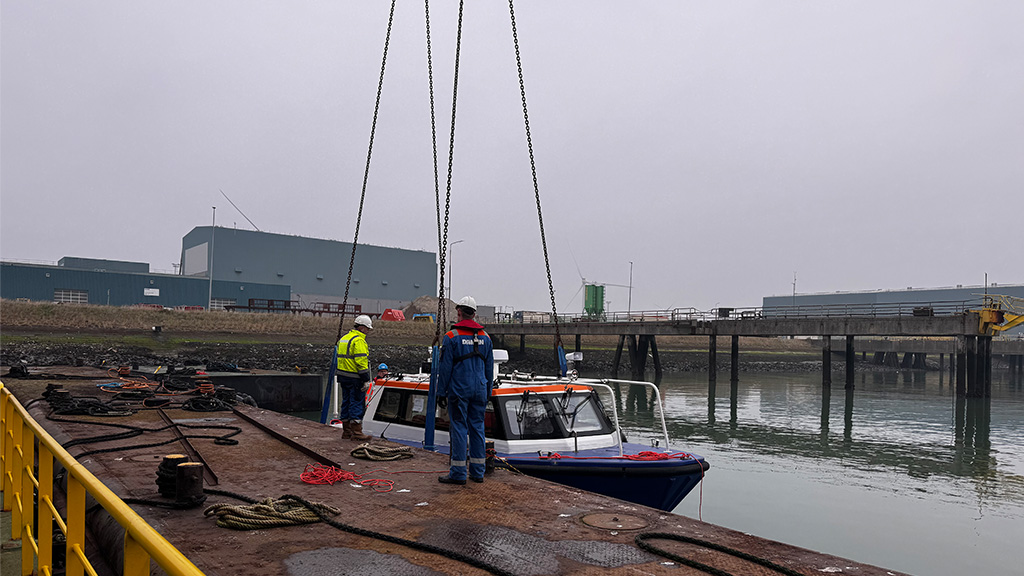 At the shipyard in Vlissingen-Oost, the F.A.S.T. boat was hoisted into the water at the end of January.
“Four years ago, we began with a short conversion period to make the boat semi-autonomous and to carry out the first research. For example, we investigated which software and sensors were needed for fully autonomous sailing,” Pieter explains. “The goal was twofold. On the one hand, we wanted to create a platform we could use to facilitate our own research into autonomy. On the other hand, we also offer other companies the opportunity to test their software, sensors, or cameras on our boat. The onboard infrastructure is universal enough to make that possible. We can plug in most systems for testing.”
Such a test platform is essential for evaluating all kinds of scenarios and seeing how the boat responds to external variables. While sailing, all water users face external factors such as currents, waves, wind, environmental influences, and other vessels. “We saw that a lot of autonomy research is simulated, but in the real environment things never follow the rules. We found that out quickly. We set up several test formations with predefined scenarios so we could see how the boat responded. We are now expanding those scenarios.”
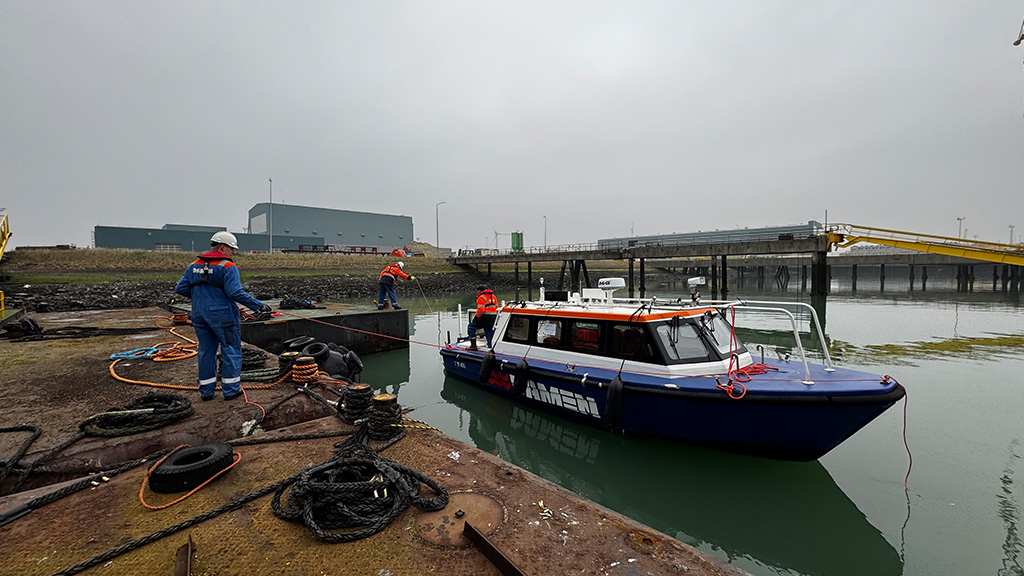 Once in the water, the boat proved to be watertight and the batteries could be charged using shore power.
Although long delivery times for battery packs and electric motor components caused delays in converting the boat to electric propulsion, the work did not stop. Research into autonomy continued steadily. Damen Naval even purchased a second platform: an Interceptor 1102. “With the Interceptor, we benefit from the knowledge we gained with F.A.S.T., but the reverse is also true. Because we had to wait so long for parts for the conversion, we discovered things with the Interceptor that we can now also apply to F.A.S.T.”
Ultimately, the goal is for the knowledge and technology from F.A.S.T. to be applied to other platforms as well. In this rapidly changing world, autonomy is playing an increasingly important role, with drones in the air and on the water. With these two projects, Damen Naval can now be part of that development. “The goal is an autonomous platform that we can offer to the market. Unmanned Surface Vessels (USVs) certainly have a future.”
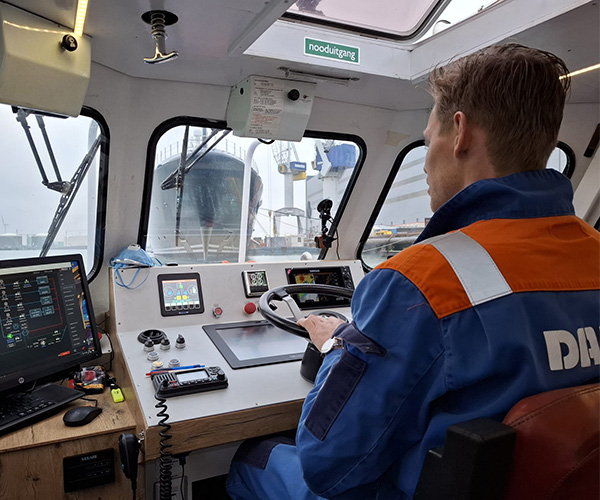 F.A.S.T. Project Manager Jochem Nonhebel at the helm.
The F.A.S.T. project is a collaboration between many different departments and specialisations within Damen Naval. The core team of Jochem Nonhebel, Pieter de Korte, Karine Jansen, John Spruit, and Amr Ranneh has received a great deal of support from the Production Department, students and interns and individual colleagues.
“Marcel van der Heijde is a real source of knowledge for us. He has a lot of practical expertise in electromechanics,” Pieter says. “The Production Department in Vlissingen-Oost also helped us with the work. For example, a special cradle was designed and built for the Stan Patrol so we can transport it easily. And there was practical help with modifications to the cooling system. With great precision, piping specialists Richard Bijkerk and Richard den Haan made changes. We also had support from Johan and Willem Huiszoon during lifting operations.”
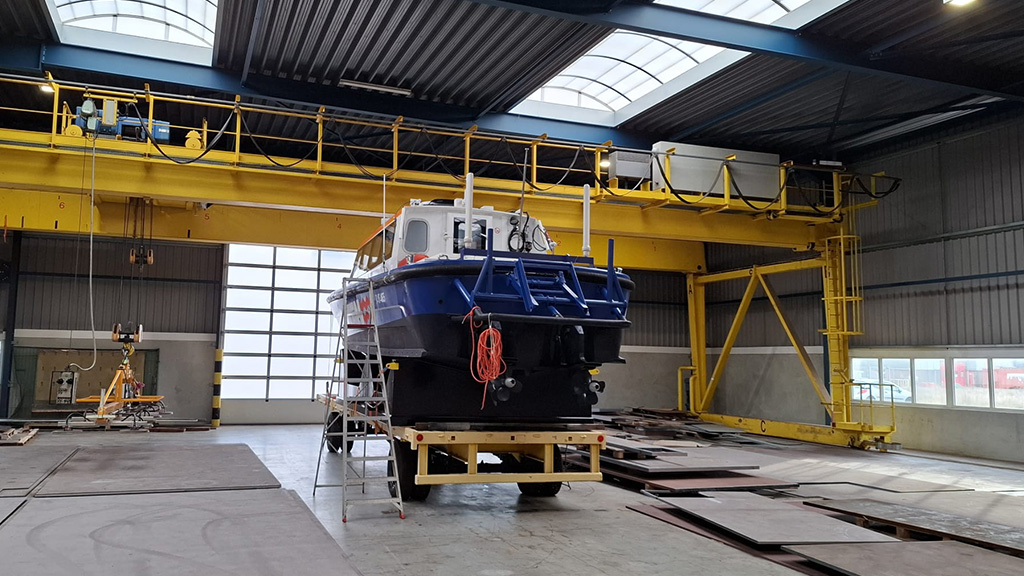 The Damen Naval Production Department has constructed a special cradle to ensure that the boat can be transported safely.
In addition, many students have come on board in recent years, a win-win situation because the extra hands are very useful and it is also a very interesting project for the students to be involved in. “We’ve had various students on board from different programmes: HZ University of Applied Sciences, TU Delft, vocational education programmes, and students who were doing internships in other internal departments,” Pieter says. “The most recent student, Icks Onrust, did an internship with the General Maintenance Department of the Production department. He carried out all kinds of support tasks for the relaunch, such as reinstalling storage boxes, mounting the seats, and installing sensors on the roof.”
With space on board for ten passengers, the F.A.S.T. boat is almost ready to sail autonomously, and the team is looking forward to showing the results of their hard work. Over the past few years, the boat has attended multiple events, and this will continue in the future. Pieter: “These events are important to show our stakeholders, new partners, students and other interested parties what we are working on.”