
 Subscribe to the newsletter
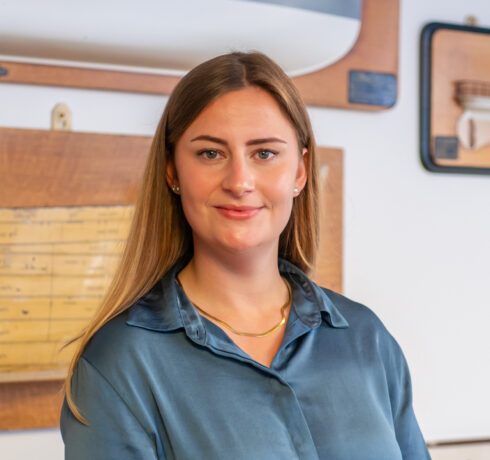
“In Services you never know exactly what will come your way,” says Jolijn Sala. But this unpredictability is actually part of the appeal. Jolijn works as a Service Engineer at Damen Naval. Her background lies in the technical track of Maritime Officer training, aimed at the merchant fleet. Marine engineer, ship machinery officer, the person who keeps systems running. She chose that direction while many women in the programme leaned towards the nautical track. She remembers being one of very few women. But no matter, says Jolijn: “Once you’ve chosen the right study and it truly fits you, everyone is into the same things. The atmosphere is good, and you have a shared passion and a shared sense of purpose.”
She joined Damen Naval first as a working student, then moved into a full role in Services. The appeal was the blend of domains. Her education trained her for operational ship work. Services added complex naval systems, design work in an office setting, and hands-on tasks on board. “It’s the best of both worlds,” she says, because she gets technical depth and practical applications in the same week.
"Predictive maintenance is a really important topic for the future, because it shifts the work from reacting to breakdowns, to reliability, and supporting the customer through the whole life cycle of the ship.” Jolijn Sala
Her graduation assignment became a blueprint for a system that now runs through her daily work. The service department already had a maintenance management system, but it did not fit the scale of what was coming. The question was not only which CMMS (Computerised Maintenance Management System) could support internal teams, but which could also connect to fleets and systems that run onboard ships. That project led to the choice for ILIAS. Jolijn has been involved in that work from the start.
The work itself takes place along two distinct timelines. One is urgent and more reactive: failed diesel engines repair requests, fast coordination with engineering when a modification is needed, a customer asking for an extra capability. The other is long term: service contracts, dockings that need preparation months ahead.
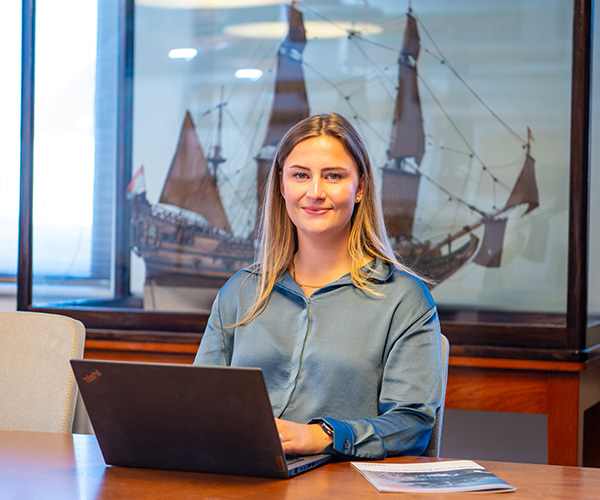 Jolijn Sala.
She has joined sea trials: “Those are great moments, when you’re there and you experience the tests onboard.” Her current involvement in one of the new Royal Netherlands Navy projects draws her further into commissioning support in the newbuild phase. “Commissioning is where everything comes together,” she says. It is also where small mismatches become visible. “Tiny deviations that don’t really stand out earlier, can later mean something simply doesn’t work.” That is why she values being involved earlier, including at supplier tests. FATs, Factory Acceptance Tests, happen before equipment is accepted, before it reaches the yard. Her team now joins more of these in an advisory role, looking for failure modes that are easier to prevent than to fix during commissioning phase.
Ask her what she wants to underline, and she returns to maintenance management. It is not background admin to her. It concerns engineering, planning, data, and foresight in one system. Predictive maintenance, tied to ILIAS, is central to this idea and to the question every operator eventually faces: how to stop problems before they become urgent failures. “That’s a really important topic for the future,” she says, “because it shifts the work from reacting to breakdowns, to reliability, and supporting the customer through the whole life cycle of the ship.”
Her advice for young people is to get a clear view of the work before choosing a field of study. “Go and look around as much as you can,” she says. “As an outsider you often don’t realise how many different functions there are in engineering.” She encourages students to seek out ship visits, open days, and chances to shadow teams, and to step on board when invitations are offered. “It gives you the context and impressions you cannot get from a classroom.”