 Subscribe to the newsletter
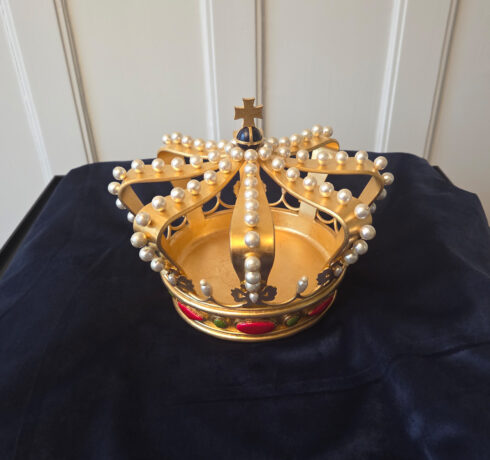
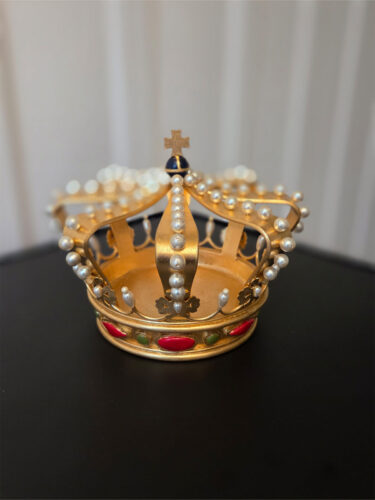
A special piece of Schelde history has recently returned to the Damen Naval Head Office. It concerns a special ship’s crown that is placed at the top of the flagpole on a naval vessel during royal visits and on public holidays. This royal crown was made in the 1980s by former Schelde employee Thijs Geuze for the flagpoles of the Kortenaer Class Standard Frigates. His family has now loaned the crown to Damen Naval, and it is currently displayed in a special showcase.
Text: Eefje Koppers
Matthijs ‘Thijs’ Geuze started at the Royal Schelde Company School at the age of 13 and worked for the company for a total of 41 years. In the 1980s, he worked there as a Machine Bench Instructor at the company school, where he and his students first made a test version and then the actual crowns for the S-frigates. Thijs was allowed to take one of the crowns home as a token of appreciation for his contribution to the project.
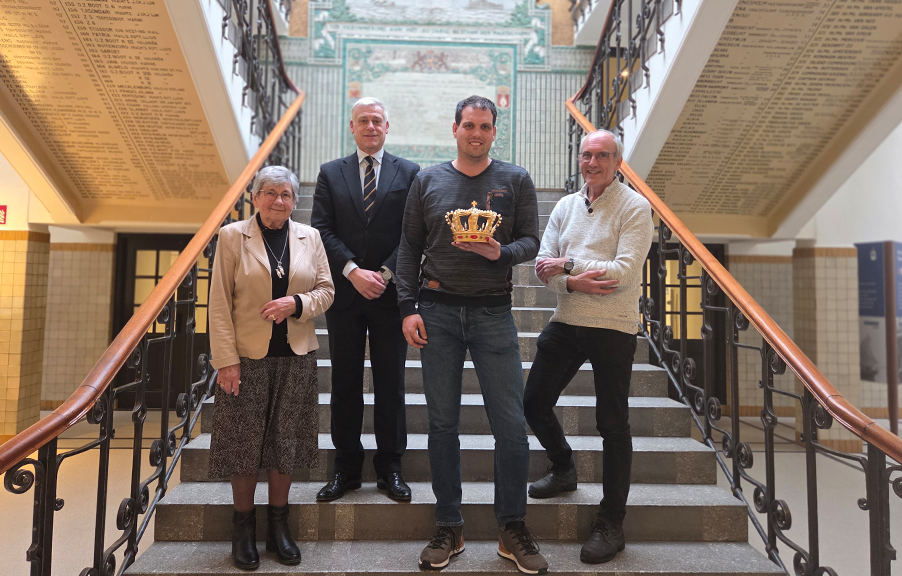 Three generations of the Geuze family came to Damen Naval to hand over the crown. (From left) Jannie Geuze-Goedbloed, Richard Keulen, Matthias Geuze, and Dick Geuze.
His grandson Matthias Geuze has been working at Damen Naval since 1 March 2025, after having worked at Damen Yachting for 14 years. He facilitated the return of the crown to the Head Office. “This is where it belongs. The crown is beautiful and deserves to be seen. At our house it was kept in a small box in a cabinet, and that’s a shame. It is much better that it is here.” Together with his father Dick Geuze and grandmother Jannie Geuze-Goedbloed, the widow of Thijs, who passed away in 2002, he visited the Damen Naval Head Office to hand over the crown.
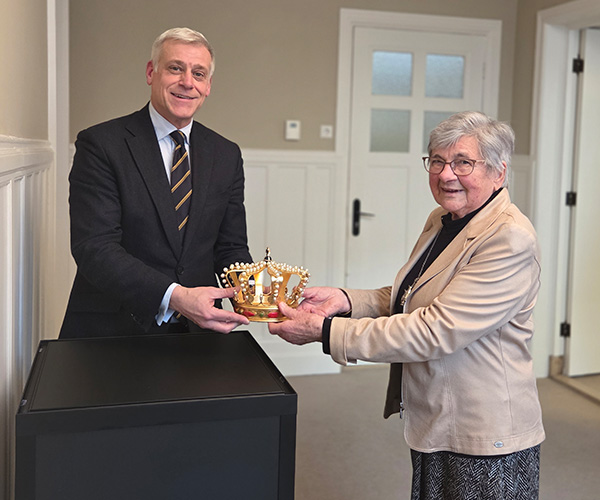 Damen Naval Director Corporate Affairs and Innovation Richard Keulen accepted the crown.
Damen Naval Director Corporate Affairs and Innovation Richard Keulen received the crown. “It is a very special piece of Schelde history. The crown was handmade here at the yard, and it’s wonderful that everyone can now see it.” During his career with the Royal Netherlands Navy, Richard sailed on several S-frigates and was familiar with the crown on the flagpole. “But I didn’t know they were made at the Schelde.”
In the Schelde staff magazine of 27 February 1981, a news item appeared titled ‘A “Royal” Assignment’. It reported that in 1980 the Company School had received a “special assignment from the Office of the Director of Newbuild Construction to supply the (royal) crowns intended for the flagpoles of the Standard Frigates. “Based on a tiny sketch from the boatswain’s manual of the ‘Banckert’ (the fourth S-frigate), a model eleven times larger was constructed.”
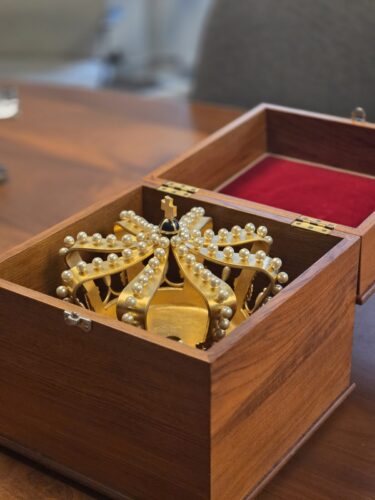
The crown is made of brass with copper details and has an outer diameter of 25 centimetres, a height of about 15 centimetres, and weighs nearly 2 kilograms. The applied decorations of rim jewels, rosettes, and the orb are coloured with red, blue, and green plastic. A total of 88 pearl beads were used, and the crown itself is gilded with gold leaf.
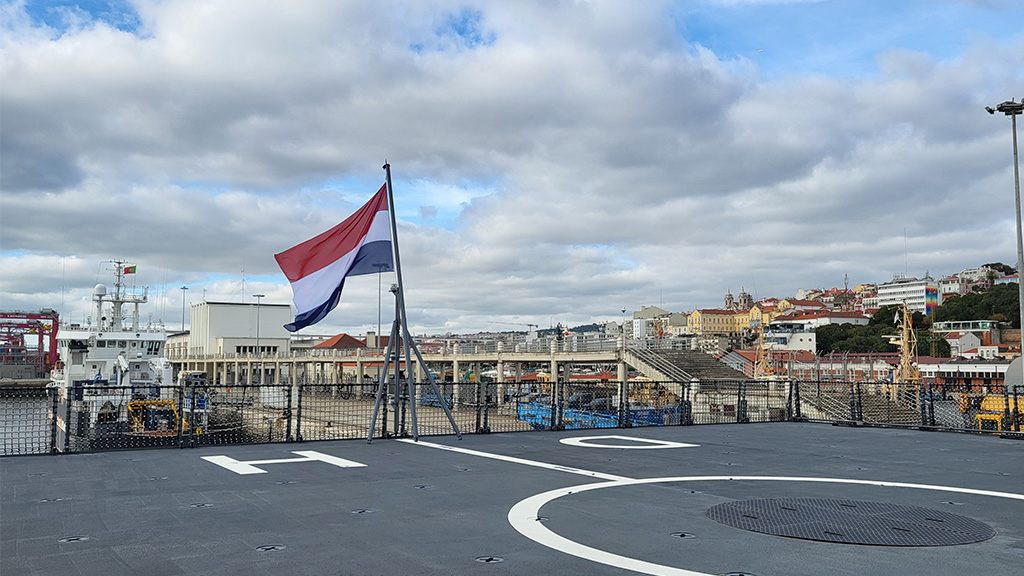 There is a hole at the base of the crown, and on flagpoles on naval vessels (such as here on the mast of HNLMS Den Helder) there is a pin to which the crown is attached.
Dick says: “My father did the gilding at our home. A special paint had to be used that needed to dry to a specific degree before the gold leaf could be applied. If the paint was too wet, the gold leaf would sink into it; if it was too dry, the gold would flake off. It had to be exactly right, and that’s why he did it at home. He could work there in peace without being disturbed.”
According to the staff magazine, the first crown was presented one day before the transfer of the Banckert to commanding officer Captain E.A. van Es by a delegation from the Company School, accompanied by company director Jan Weug. “During the commissioning of the ship, the Netherlands flag therefore flew doubly royal.”
The second example was presented on the occasion of the change of command on board HNLMS Callenburgh on 21 January 1981. The remaining crowns were handed over during the transfer or commissioning of the other S-frigates still under construction. Ships already in service “were crowned on a suitable occasion or during a visit to the yard.”
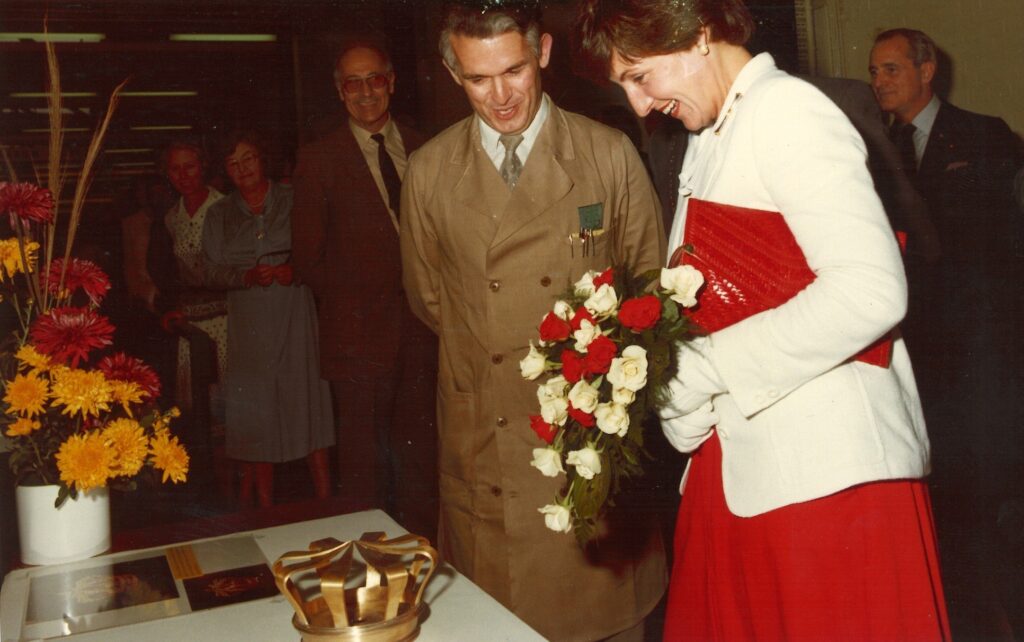 During the opening of the new Company School in 1981, Princess Margriet admires the crown made by Thijs Geuze (left).
Of the 12 frigates of the Kortenaer class, ten were built in Vlissingen and two by Wilton Fijenoord in Rotterdam. During construction, two frigates (Elli and Limnos) were sold to Greece. The remaining ten served in the Royal Netherlands Navy.
The royal crown is a special tradition for naval ships. Flagpoles on board a naval vessel have a special pin at the top that passes through the hole in the crown. When the ship is in port, the crown is placed on top of the mast on public holidays and during royal visits to the ship.
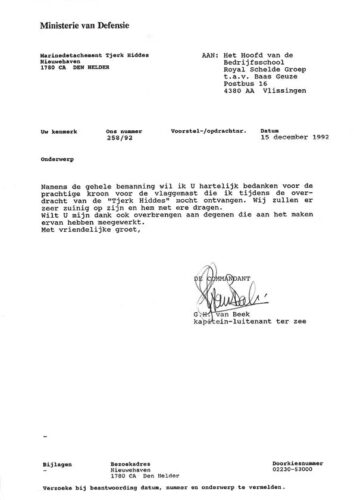
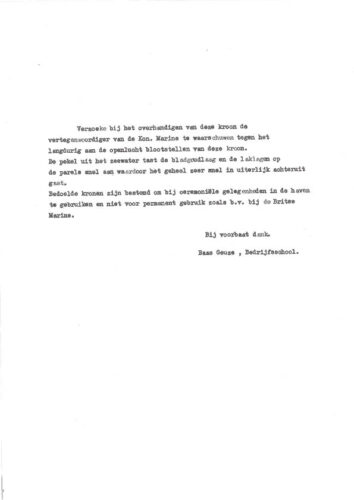
See below for additional images of the crown and letters written by the commander of HNLMS Tjerk Hiddes and Thijs Geuze.