
 Subscribe to the newsletter
What first draws the eye as we enter the Zeeuws Archief (Zeeland Archives) depot is a small collection of paper ephemera straight from a mid-century traveller’s pocket. There’s a berthing card from the Swedish American Line with a pink boarding slip and a booklet from the 1953 maiden voyage of the MS Kungsholm.
The ship sailed from Göteborg to New York, and its on-board programme comes from a time when crossing the Atlantic still carried a sense of elegance. Recorded music played in the lounge, sweepstakes took place on deck, films were shown before dinner, and smorgasbord was served at eleven to curb a late-night appetite. The cocktail menu offered a Kungsholm Special for 40 cents, alongside the classic lineup of drinks any mid-century jetsetter would expect.
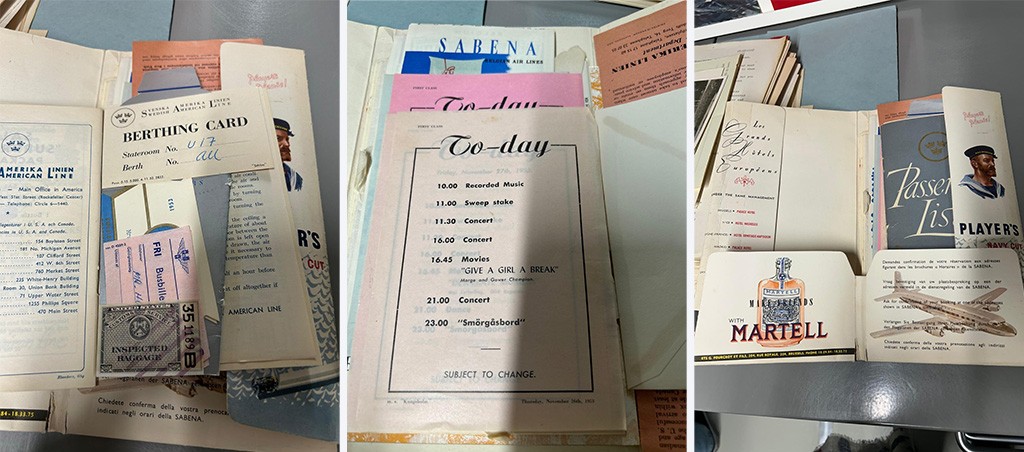 Mid-century travel ephemera.
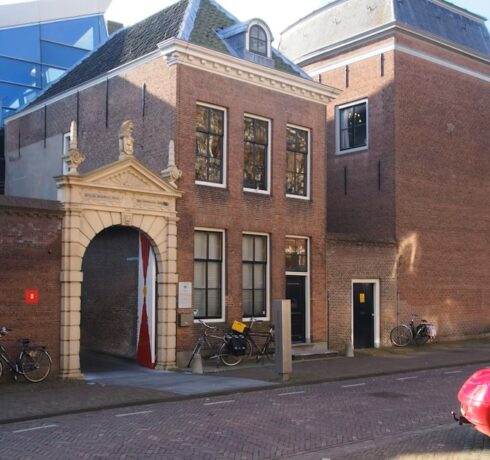
The Zeeuws Archief is located in the Van de Perrehuis in Middelburg, an eighteenth-century city palace. A modern extension contains the depot and the public reading room and together, these spaces hold all the sources that document the province. According to information from the Zeeuws Archief, this includes court archives, municipal files, notarial deeds, private papers and company archives; in total more than thirty-six kilometres.
We are one of two groups of Damen Naval colleagues who were welcomed for a behind-the-scenes visit by Lindy Huibregtse, Communications Advisor, and Roosanne Goudbeek, Project Leader concept and creation at the Zeeuws Archief. To access the main depot, you descend 14 metres underground. The staircase leads to a sealed climate chamber designed to protect the collections. As we pass through a small airlock, a second door opens, and we step into the records of another time.
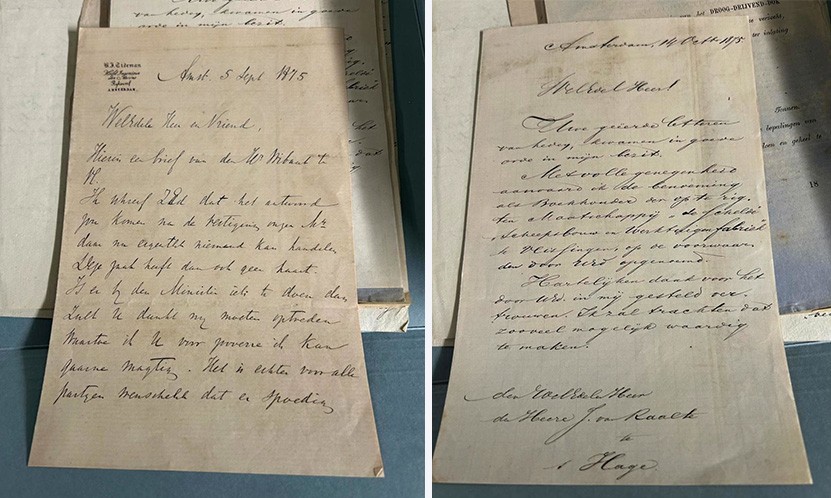 Handwritten letters from B. J. Tideman (left) and J. van Raalte (right).
Here, a stack of handwritten papers traces the early history of the Royal Schelde. You might lift a 1915 letter from B. J. Tideman, chief engineer of the Royal Navy at the Rijkswerf Amsterdam, written in an elegant hand on his own letterhead. Or an 1875 letter to J. van Raalte at the newly formed Maatschappij De Schelde, in which a new bookkeeper accepts his post in Vlissingen, under the agreed conditions.
These letters are part of the most complete shipyard archive in the Netherlands. They hold more than 250 metres of documents, drawings, glass negatives, and correspondence. The collection is part of the Dutch UNESCO Memory of the World Register. As Roosanne notes: “The Schelde archives are iconic for Dutch shipbuilding. They are the only ones in the Netherlands that document the full history of shipbuilding between 1875 and 1970 in complete detail.”
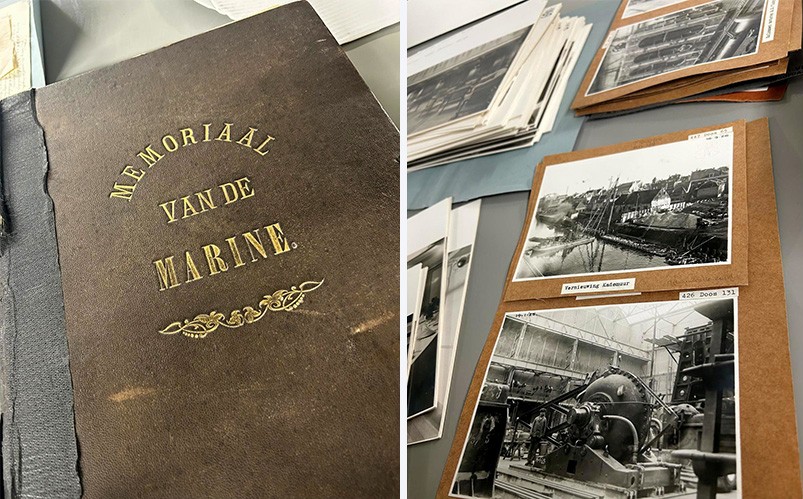 Copy of the book "Memoriaal van de Marine" (left). Archival photographs (right).
Stretched across a wall is a cyanotype blueprint of the cruiser Noord-Brabant. Beside it lies the detailed engine plan that formed part of the shipyard’s submission to the Exposition Universelle in Paris in 1900. The Schelde received a gold medal there, a moment that brought international recognition. An elegant Belle Epoque letter from the firm Lathoud Aîné, which held the exclusive rights to reproduce the exposition medals, offers further proof of this distinction.
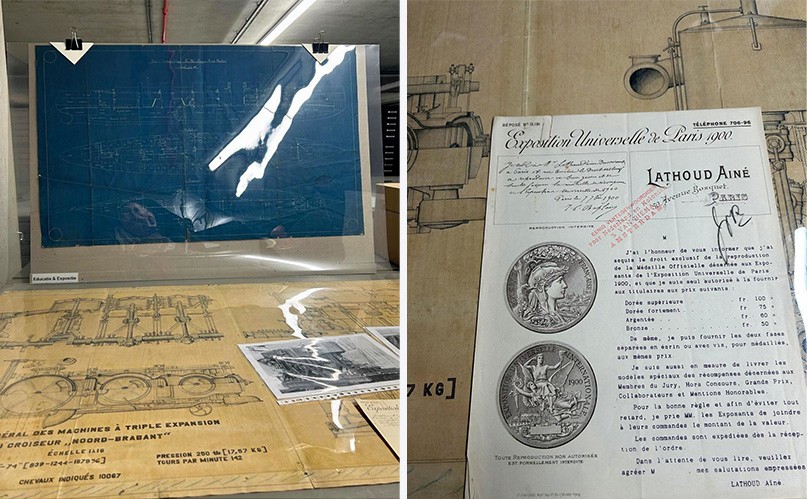 Blueprint of the Noord-Brabant cruiser (left). Archival documents (right).
These paper ephemera, and much more, were pre-selected for our visit, but the collections are accessible to anyone. Visitors can consult materials in the reading room by appointment, with staff helping to locate items and prepare documents in advance. A large part of the Schelde archive is already digitised and available through the online catalogue, and additional scanning requests can be made. A century and a half of Royal Schelde history is preserved with care here, and available to anyone who wishes to consult it.
Lindy: “I enjoy welcoming Damen colleagues and showing them what the Schelde archive contains. They are often deeply committed to their work and to the company’s history. By sharing these stories, we keep them alive and learn from the past for the future.”
Back at street level, we are left with the starry sense that the couple of hours just passed belonged to a different register of time.
Text: Rachel Nefkens